
Lay for the Day  8th
October
8th
October
1871: the Great Fire of Chicago breaks out and in two days destroys the
majority of the city. Its reconstruction provided a laboratory for new
styles of building, notably the steel-framed skyscraper. The hubbub of
work, still going on a dozen years later, made Chicago the natural destination
for a gifted young architect from Wisconsin, Frank Lloyd Wright, who was
to become one of the great artists of the United States.
In the area of London described below, the monumental commercial style established in late nineteenth century Chicago is dominant, while the “organic architecture” that Wright espoused is almost entirely absent.
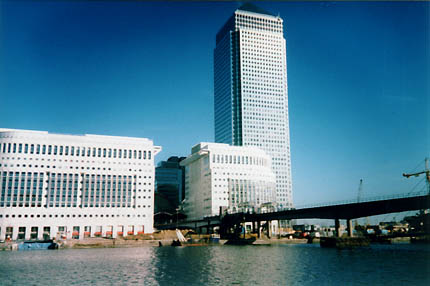
Canary
Wharf, 1997. Photo: John Gibbens
‘Fox at Canary Wharf’ was written in the mid-1990s, when the Docklands project was still in its infancy. Later parts of the poem (for example, the part that’s the Lay for 4th May) speculate whether the whole development could grind to a standstill. This has been resoundingly disproved, and new developments have mushroomed around the original Canary Wharf tower (officially “1 Canada Square”). Corporate tenants have filled up the space, and workers, shoppers, eaters and drinkers flock in.
Commercial
wealth is matched, however, by architectural poverty. A change of fortune
would soon return the place to the gigantic desolation of the derelict
docks that preceded it. The ruling aesthetic, established by the original
tower, seeks to impress upon the individual his or her smallness and insignificance
on the economic scale. Frank Lloyd Wright’s aim, on the other hand,
was to enhance both the environment his buildings occupied and the lives
of the people who occupied them.
Fox
at Canary Wharf (first
part)
Delivered into the dream of
steel
what
was that glimpse?
where the light railway bends sharply
gingerly curves through 90 degrees
on its untidy trackway
all
hi-tech
it’s
all still perilously
up
in the air
with a sharpish squealing
and brings us at a certain elevation
that
glimpse of rufous fur
this toy-like train, to our destination
the wind-tunnel of Canary Wharf station
Bloody wind
like
some revenge of nature
cold colourless and unending
against the cold and colourless
and would-be unending building
through every would-be public space
Coming in at the north door
of Cabot Place East
out of the bloody wind
into the dream
the
oddly prosaic dream
a man was delivered down diagonally
before my eyes
in
mid air
of course I mean on an escalator
and
who did he remind me of?
a man who comes down an escalator
while
others go up
to all intents and purposes identical
and identically shaped women
pause
by shops
in an architect’s rendering
Confessions
of an ant:
what glimpse of a point
of a white tip to it?
I
left and went
until I lost the scent of my fellow workers
It
wasn’t far
till the smooth stone gave way
and the benches, railings and trees identical
to all intents and purposes
gave way to water-eroded
stone and long beams of rotten wood
and a beautiful length of green
old rope lurking half-submerged
and I’d got as near as I could
to eye-level with the river
and I sat on a stone and smoked
and no-one looked
John Gibbens
from Sand of the Thames
The
Lay Reader: an archive of the poetic calendar
